Key Facts
- Categorized as a Near-Earth Asteroid of the Amor group
- Orbits in near-Earth space, between Earth and the inner edge of the main belt
- Comparable in length to the Golden Gate Bridge (2.74 km diameter)
- Is a Near Earth Object
- Not a Potentially Hazardous Object
- Considered accessible to spacecraft — listed in the NHATS study
- See orbit simulation
Overview
Tenev is a near-Earth asteroid of the Amor group. Unlike the majority of catalogued asteroids, it does not live in the main belt between Mars and Jupiter. Its entire orbit sits in the inner solar system: at its closest to the sun it comes within 1.22 AU, just outside Earth’s own orbit, and at its farthest it reaches 2.47 AU, brushing the inner edge of the belt. Amor asteroids like this one approach the orbit of Earth from the outside but never cross it.
Tenev completes one trip around the sun every 913 days (2.50 years), travelling at an average speed of 21.94 km/s. It is roughly 2.7 kilometers in diameter — large for a near-Earth object, and comparable in length to the Golden Gate Bridge. Its surface is unusually bright for an asteroid, reflecting about 28 percent of the sunlight that falls on it, which points to a stony (S-type) composition rather than a dark carbonaceous one.
The rotation of Tenev has been observed. It completes a rotation on its axis every 7.16 hours.
NASA JPL has not classified Tenev as potentially hazardous. Although it is a near-Earth object, its orbit keeps a comfortable distance: the two orbits never come nearer than about 0.22 AU, roughly 85 times the distance to the Moon.
Close Approaches
Tenev’s orbit is 0.219 AU from Earth’s orbit at its closest point. Orbital simulations show several approaches over the coming century, none of them hazardous.
| Date | Distance (AU) | Lunar distances | Relative velocity |
|---|---|---|---|
| March 12, 2029 | 0.2341 | 91.1 | 8.94 km/s |
| Sept. 28, 2034 | 0.1874 | 72.9 | 9.61 km/s |
| July 4, 2041 | 0.2508 | 97.6 | 8.42 km/s |
| Nov. 19, 2056 | 0.1663 | 64.7 | 10.13 km/s |
Images and Observations
The orbit of Tenev is determined by observations dating back to April 18, 2013, when it was first picked up as provisional object 2013 HD8. It was last officially observed on Feb. 2, 2026. The IAU Minor Planet Center records 1,873 observations used to determine its orbit.
Name and Citation
Minor planet 641987 received its permanent number in 2026, once its orbit had been secured across four oppositions, and was named Tenev at the proposal of the discovery team. The name honors a contribution to widening public access to markets and financial information. The citation was published in the Minor Planet Circulars alongside the permanent designation.
Accessibility and Exploration
Because it orbits close to Earth and moves slowly relative to it, Tenev is considered a viable target for human exploration by the NHATS study. The most favorable round-trip profiles depart during the 2034 approach window and call for a total delta-v of about 5.9 km/s over a mission lasting some 380 days.
Similar Objects
These objects have orbits that share similar characteristics to the orbit of Tenev:References
Location
- Region: near-Earth space
- Group: Amor
- Between Earth’s orbit and the inner main belt
- Earth MOID: 0.219 AU
Orbital Elements
- Epoch: 2461200.5 JD
- Semi-major axis: 1.842 AU
- Eccentricity: 0.3384
- Inclination: 11.42°
- Longitude of Ascending Node: 148.06°
- Argument of Periapsis: 92.73°
- Mean Anomaly: 214.85°
Physical Characteristics
- Diameter: 2.74000 km
- Magnitude: 14.81
- Albedo: 0.284
- Spectral type: S
Derived Characteristics
- Orbit Period: 913 days (2.50 years)
- Avg. Orbit Speed: 21.94 km/s
- Aphelion Distance: 2.47 AU
- Perihelion Distance: 1.22 AU
- Rotation Period: 7.16 hours
Orbit Simulation
Sky Map
The position of Tenev is indicated by a ◯ pink circle. Note that the object may not be in your current field of view. Use the controls below to adjust position, location, and time.
Size Rendering
The comparison below is an artistic rendering that places Tenev against the Kangchenjunga range (main summit 8,586 m) for scale. It is built for full-resolution desktop browsers. The body inside the ring is a NASA photograph of 101955 Bennu, another near-Earth asteroid, captured by the OSIRIS-REx spacecraft and used here as a stand-in — only the size is derived from the data for Tenev, which at 2.74 km would stand roughly a third as tall as the peaks behind it.

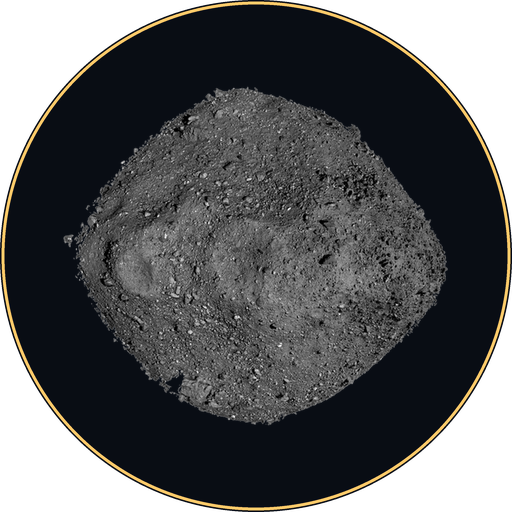
Background: Panorama of the Kangchenjunga range from Sikkim by Carsten.nebel, CC BY-SA 3.0. Asteroid image courtesy NASA / Goddard / University of Arizona.